Here I go again. Another great visualization with data displayed accurately, but great opportunity for misrepresentation.

Here I go again. Another great visualization with data displayed accurately, but great opportunity for misrepresentation.
Some commentary accompanying the map suggested that higher costs of housing and living is the cause of “young people” living with their parents. Some reposts used it for bragging rights.
Do we have a housing problem in the United States? Absolutely.
Do high housing costs contribute to some young people living longer with their parents? No doubt.
Does this visualization provide proof? I’d say no, and that’s important because if your proof source is shaky, your argument is weakened, not strengthened.
Her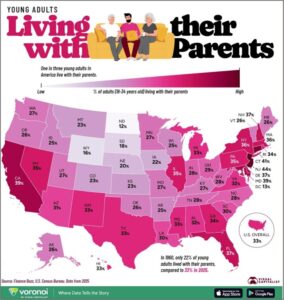 e are a couple of reasons this one looks more like correlation than causation to me.
The definition of young adults starts at age 18. From about 18-22, many may still be in school, perhaps “away” at college but still resident with their parents. Are we really saying that this younger cohort “should” already be out on their own full time?
Second, there is a callout indicating that in the 1960s only 22% of young adults lived with parents, versus 33% today. The implication seems to be that this is evidence of a deterioration over time caused by housing costs, but a lot can change in 60 years. We are spending more time in school. We are marrying or partnering up later. Our society is also more diverse, and includes more cultures for whom a multi-generation household is not a last resort option.
Here’s a fun fact – in the 1960s the average age of getting a drivers license (a key sign of independence) was 16, now it’s 18. That’s got nothing to do with housing affordability, but does perhaps speak to a shifting of the age of independence.
I can’t parse the data to pull out the 18-22 year olds, but it would be interesting to see how adjusting for median age, marriage status, and proportions of college students might impact the patterns.
Or better yet, put the energy toward creating and sharing solutions instead of looking for ways to prove your share of the problem is less bad than someone else’s.