
 Roughly 1 in 4 practicing physicians in the United States are either foreign born or received their training outside the United States. In rural areas, the proportion is closer to 1 in 3. Though only 1-2% of students in U.S. medical school are foreign born, 25-30% of medical residencies are filled by international physicians in training.
Typically these medical residents study under a J-1 visa. Those who agree to then work in a federally designated shortage area have typically received a 3 year J-1 waiver. When policy delays granting those waivers, these residents must leave the country and wait two years to apply to return, usually under the H1-B visa program. That’s the program that now has a $100,000 fee attached. The Cato Institute, generally considered to be a conservative think tank, released a commentary in May 2026 expressing concern about the phenomenon.
In May 2026, the United States clarified that physicians would be exempted from the 39 country visa processing hold/travel ban that took effect in January 2026, but the exemption did not result in speeding up approvals for applicants from all countries. Further, neither medical students nor family members of physicians are exempt.
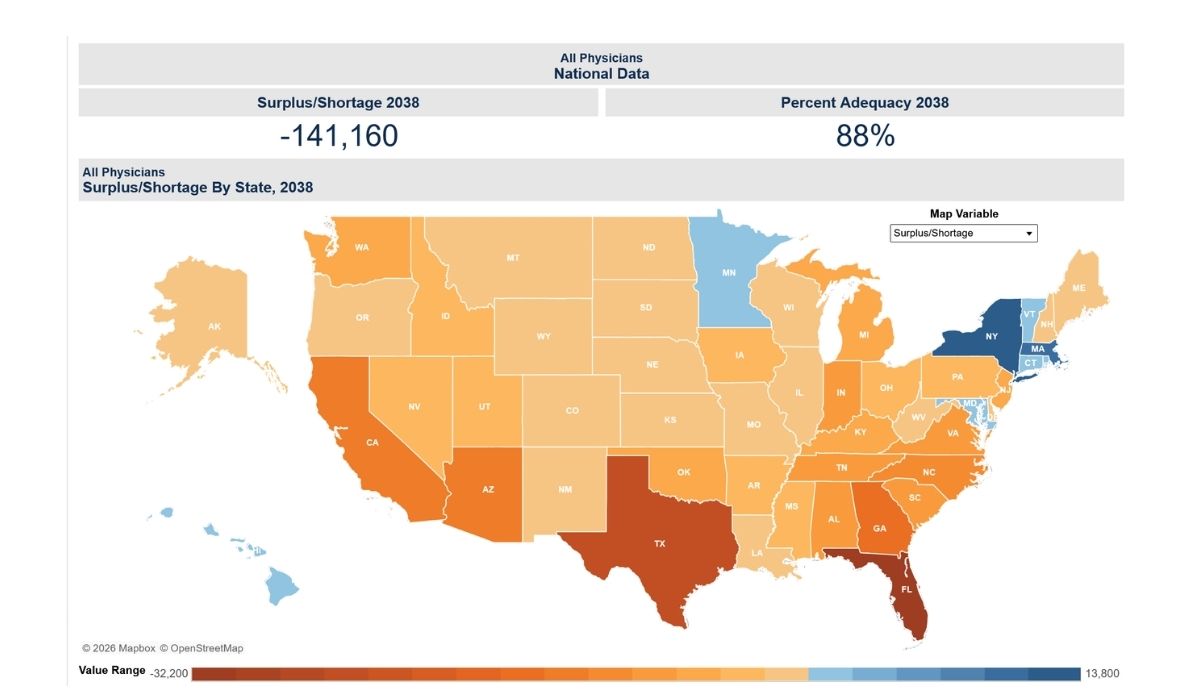
Meanwhile, the excellent data that continues to be available from the Health Resources and Services Administration on Healthcare Workforce Shortage Areas and Medically Underserved Areas says, plainly, that we already have significant shortages that are expected to deepen. Rural areas, as is often the case, are especially hard-hit, estimated to have only 45% of the physicians required by 2038.
These shortages are widely expected to become worse due to both the aging of the population (demand increases) and the expected retirements of large portions of the current workforce (supply decreases). Though medical school enrollment overall reached historic highs during the 2025-2026 year, in 2026 federal put in place a student loan cap for medical school and doctorate programs.
Meanwhile, most other developed countries are also experiencing shortages. Canada, for one, is actively recruiting U.S. licensed physicians; during the first months of 2025, there was a 750% increase in doctors taking the first steps to relocate compared to the previous year.
Policy in action.