
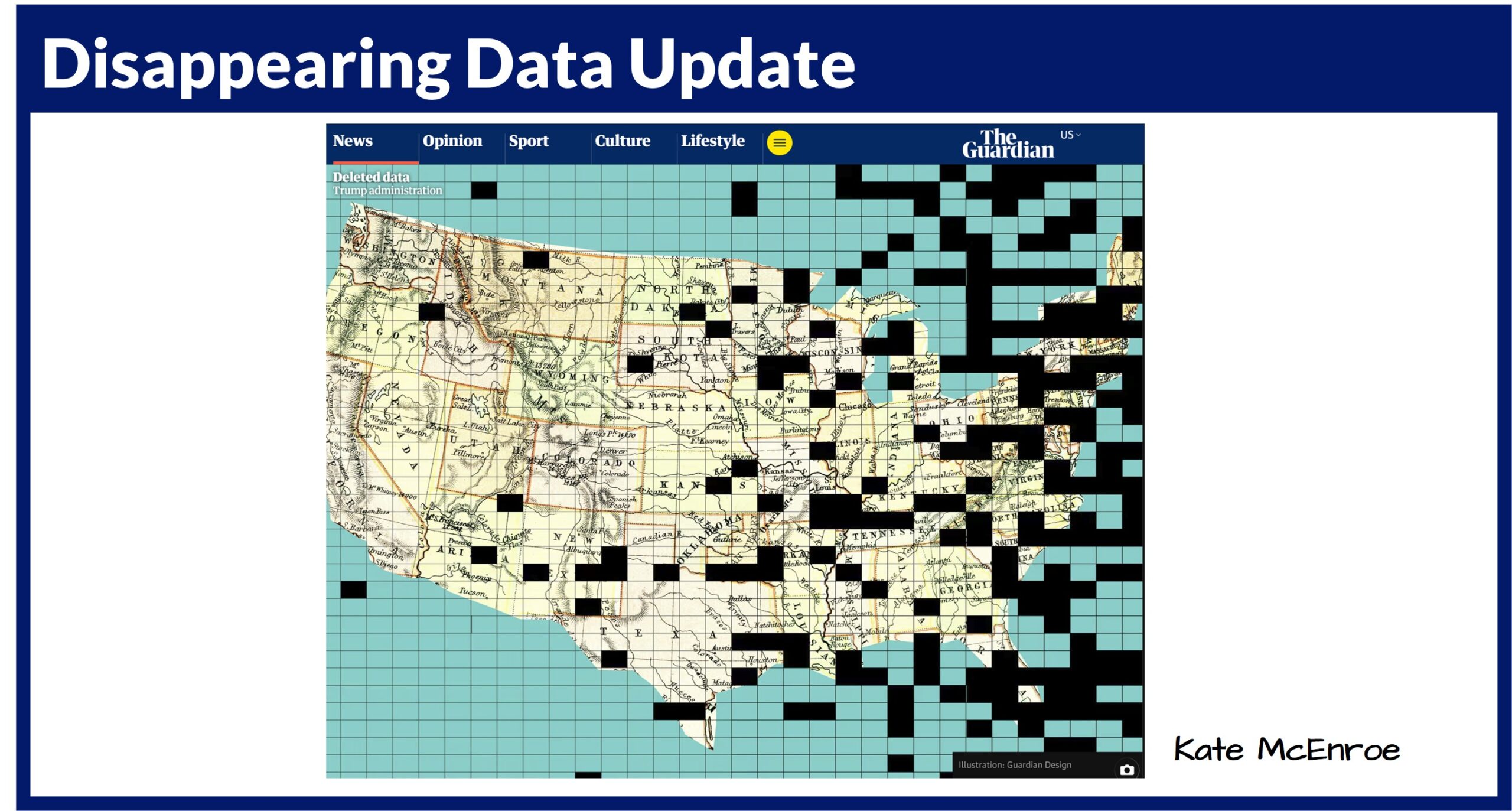
 Thousands of government data sets have been removed from public access and data collection programs have been suspended since early 2025.
In May, the Guardian published a piece detailing 5 ways that average Americans may be impacted, and in June launched a new series that will continue to track and investigate the implications.
Will any of this missing data matter to economic developers? I’d say if it impacts your people, it impacts you. And it may be a case of not knowing you’d miss it until it’s gone.
There are a number of initiatives underway to capture data in the wild. If you are looking for something you can’t find, or have access to a downloaded snapshot of information that has disappeared, take a look at the Data Rescue Project or The internet Wayback Machine, Also, check in with your local University. Several, including Tulane, University of Maryland, American University, George Mason, and the University of North Carolina and many more, have archives of their own, and have published guides to other resources.
Here’s another local solution – in many cases federal data sets are fed from the bottom up, so check with your people – are they still collecting data locally? Have they stopped because funding was cut? Is there something you can do about that? We’ve all seen situations where a relatively small grant can make a big difference. If I were a state or local economic developer, I’d want to use my ability to convene and facilitate to hear directly from the people who use the disappearing data, and let them make their case for why your community should still care about it. Trite but true, we don’t fix what we don’t measure.